

How To Clean Concrete Residue From Stone
If you'd like professional person help, contact a contractor offering concrete cleaning near me.
HOW TO REMOVE OIL STAINS FROM Physical
Question:
Does your concrete driveway or garage floor take cruddy oil stains?
Answer:
It'south important to remove oil before staining, sealing or resurfacing your concrete. If the oil isn't removed information technology will somewhen seep back through to the surface and ruin your new decorative treatment. Learn how to avoid this problem past removing the oil stains from your physical.
DEALING WITH MOLD ON Physical
Question:
I live in northeastern New Jersey, and in June we had weeks of pelting and humid conditions. Some areas of my concrete driveway developed black spots, and other areas under pino trees have turned green. What is this stuff, and how do I remove information technology?
Reply:
The wet conditions you experienced caused mold and mildew growth on the physical. This growth usually occurs in damp or shaded areas that don't receive a lot of sunday or heat. Physical, with all its nooks, crannies and pores, is actually a great incubator for mold. Wet, humid weather with warm temperatures simply improves the growing conditions. For the solution, read: Dealing with Mold on Concrete.
Featured Cleaning Products
REMOVING Foliage, PINE CONE AND OTHER ORGANIC STAINS FROM Concrete

Question:
What'southward the all-time method for removing leaf, pine cone and other organic stains like urine, blood or sap from physical?
Answer:
Because organic stains are carbon-based, they tend to exist some of the most stubborn stains to remove from physical. They are not permanent, but they can exist hard to remove. The organic pigments get embedded in the micro-pores and small voids on the surface of the concrete. Organic pigments and oils can be very tough stuff, as anyone who has tried to remove grass stains from habiliment or clean pino tree sap from hands can attest.
One reason you lot may exist having express success in removing these types of stains on concrete is that you are using the wrong cleaners. Organic stains require special cleaners targeting organic cloth. Your typical inorganic concrete degreaser, acrid or lather volition practise next to nothing to remove these types of stains. The best detergent to u.s. is one with bleaching activity or ammonia. Typically, detergents designed to remove organic stains (blood, food stains, etc.) piece of work best; OxiClean is one instance. Granular detergents offer an added do good, because they provide additional friction when you scrub the surface.
The other factor at play is time. Organic cleaners are fabricated up of enzymes and bacteria that actually swallow or interruption down the organic fabric making up the stain. This digestive procedure is slow, and almost organic cleaners require a minimum of 24 hours and possibly every bit long as 48 hours to work earlier you can reapply them. Organic cleaners typically practice not affect the concrete colour or damage the surface considering the enzymes only go later on organic textile, and concrete is as inorganic as you tin get. Organic cleaners are readily available at pet stores (dog and cat urine are the nearly mutual organic stains) every bit pet odor and stain removers, as well as through janitorial supply outlets and online straight from the manufacturers.
Here are the basic steps to follow:
-
Employ a pressure washer to remove all solid leaf thing or debris from the physical.
-
Apply an organic detergent (as recommended higher up) to clammy concrete. Allow it sit for a few minutes.
-
Scrub vigorously with a stiff broom or scrub castor.
-
Rinse the concrete with water until you remove all the soap.
If this procedure doesn't completely remove the stains, echo the process. Information technology'due south of import to note that spot cleaning just those areas where at that place are stains can result in blotchy physical. I recommend cleaning the unabridged physical slab, or least a larger area, to avoid having blotchy bleached spots.
REMOVING FERTILIZER STAINS FROM CONCRETE
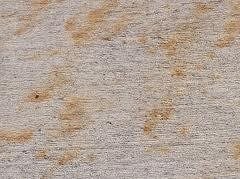
Stains on a concrete patio resulting from plant fertilizer.
Question:
I have a concrete patio and used a plant food chosen Flower Booster when watering the planters on the patio. The next day, I noticed everywhere water ran out of the planters, it stained the concrete. I have tried scrubbing with a brush attached to a power-scrub setting on my hose. What tin can I practice?
Respond:
Plant food and fertilizers all incorporate metals and minerals such as magnesium, iron, copper and zinc. This list of ingredients reads very much like that of physical acid stain. In essence, y'all stained your concrete with plant food. The minerals accept penetrated the concrete and reacted with the cement to form a permanent colour change. The reacted minerals are not water-soluble, which ways h2o and scrubbing volition non remove them. They are only soluble in a mild acid solution.
I would start with a articulate white vinegar, diluted 50:50 with water, and run into if that brings the stains out. You volition need to utilize the acid solution on the stain multiple times, scrub lightly, and and then rinse. Test in a minor area to ensure you are getting the results y'all desire. If the vinegar does not work, you may need to endeavor a stronger acid, such as muriatic. Dilute the stronger acid twoscore:1 with water. Likewise, exist aware that the acid may etch or change the profile of the physical in the areas you lot make clean.
CLEANING CONCRETE COUNTERTOPS, TUBS & SINKS
Question:
What'south the best cleaning method to use for concrete tubs, sinks and countertops that receive daily apply?
Respond:
Physical counter and tub surfaces tin can be very porous unless they are sealed. If your physical isn't sealed, I recommend applying a penetrating sealer. You tin likewise consider a topical membrane sealer, but this will have a sheen and may require more than maintenance. (Come across Physical Sealer Types.)
As a general rule, pH-neutral cleaners are best for concrete surfaces. If yous have hard water, apply a scum or hard water deposit remover. Do non utilize aggressive scrubbing pads or annoying cleansers. Even with cleaning and sealing, physical will age and vesture like any other surface, merely this can actually add character since concrete is a natural material.
INSULATING FOAM STAINS ON CONCRETE
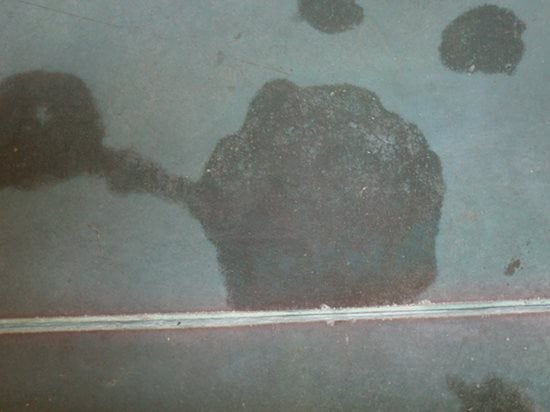
Areas where spray foam insulation dropped on concrete will resist acid stains and dyes.
Question:
How practice we remove rest from spray foam insulation that dropped on physical from the ceiling in a higher place so we tin can stain the physical? Nosotros scraped off the residuum, simply volition that spot resist stain penetration? What should we use to make clean that area?
Answer:
Most spray cream insulation is made from polyurethane. Whether the insulation is pure polyurethane or a new-generation soy-based foam, it volition be sticky and expand into and onto anything information technology touches. When the foam is first sprayed, it'south a pasty liquid. This liquid gets into the pores of the physical, and as it expands, it is forced deeper into the concrete. In essence, you have foam-insulted the top layer of the concrete, and these areas will resist the stain and show spots when the stain is applied. In some cases, they may even resist the sealer.
Scraping away the textile just removes the cream that is higher up the concrete surface. The cream that remains beneath the surface needs to be removed by chemic extraction. This involves using a solvent or chemical cleaner that volition dissolve the foam residue, and then extracting the liquefied cream from the concrete. A solvent similar acetone or xylene or an oil-removing chemical usually works to liquefy the foam. Only the extraction process is more hard. Getting the viscid liquefied cream residual out of the concrete unremarkably requires dabbing the expanse with cotton rags multiple times to try and soak upwardly the rest. Hot water pressure cleaners also work, but create a lot of mess.
Foam spots are very stubborn, and even after the cleaning and extraction process, some pocket-size stain or spot is likely to remain. I typically tell people that the best they can hope for is to minimize the spot and then the stain color is only slightly lighter than the surrounding surface area.
REMOVING Carpet Glue OR MASTIC RESIDUE
Encounter the full guide on removing mucilage from concrete.
Question:
I pulled rug from a room and so cleaned the underlying concrete floor at to the lowest degree eight times with a trisodium phosphate (TSP) solution. I also used a production from Home Depot called Jasco (a no-rinse TSP substitute) to clean the hard-to-remove glue. I washed the floor several times with water and let information technology dry. Next, I applied two coats of Kemiko stain with a garden sprayer followed by three coats of Chem-Coat sealer, applying information technology as directed with a lamb's wool mop and allowing information technology to dry out between coats. Finally, I applied a Chem-Coat protective terminate. The flooring came out beautiful, but subsequently it dried I saw a small expanse of the surface where it looked like the sealer or finish coat did non take. Information technology appears as beaded-up water and does not smoothen in that area. I would similar to correct the problem considering information technology's noticeable, merely I don't know what to do. Can you offer suggestions?
Answer:
Carpet mucilage is some of the about stubborn stuff out there. I am impressed that y'all took and so much time to clean it off. Most stain applicators I know would just identify a microtopping over the concrete and stain the microtopping vs. taking time to strip off big areas of glue residual.
As far as the sealer beading up, information technology sounds similar some remaining glue residue is causing "fish eyeing." This phenomenon occurs when chemical contamination interferes with the sealer'south ability to wet out (i.eastward., penetrate into the surface). My suggestion is to utilize several coats of finish wax to even out the gloss. If that doesn't do the flim-flam, y'all may have to go dorsum and strip and reclean that area. This is a messy, fourth dimension-consuming job and in that location's no guarantee it volition solve the outcome. Usually the awarding of floor wax does the trick.
Question:
I used Bean-due east-Doo (a soy-based mastic remover) to remove carpeting mastic from a concrete floor in my home. The mastic remover has left an oil/grease stain pattern all over the flooring. What product is best to remove the stains?
Answer:
A good soap and water cleaning using a physical alkaline degreaser soap should help. You lot should exist able to get a concrete degreaser at a hardware store.
MOSS REMOVAL FROM Physical
Question:
I accept concrete pavers and bricks in my backyard. The trouble is I am getting moss growth on them. I powerwashed the moss away last year, only information technology's back over again this year. Do yous know what's causing this to happen?
Respond:
Bricks and concrete pavers are very porous, like sponges. They hold wet, and thus are great trivial incubators for all kinds of plant life, especially moss. My approximate is you live in a warm and humid climate. You volition need to apply a weed and grass killer to the moss and then aggressively power launder all the plant matter abroad once it dies. Permit the pavers dry, and then seal them with a production designed for concrete pavers or brick. This should eliminate or at least greatly reduce the trouble. It may take several coats of sealer to completely make full all the pores in the pavers.
PROTECTING A Concrete SURFACE FROM Contagion Past OTHER TRADES
Question:
What is the best style to prevent stains from structure-related activities on a newly poured slab intended to be an exposed concrete cease (other than hounding the GC to be tidy)? I'm worried nigh contagion by muddy footprints, rainwater/dirt runoff, rusting rebar or tin can cans left on the concrete surface, and slurry from sawcuts. What combination of hardening agents, sealers, or protective temporary coverings (polyethylene, burlap, etc.) yields the all-time protection without calculation undue expense?
Reply:
Other than urging the general contractor to proceed the flooring clean, there are two industry-accepted methods that I have experience with and that piece of work well:
- Apply a cure-and-seal every bit function of the finishing process. This provides a good cure and leaves behind an acrylic membrane to protect the flooring from typical construction traffic and debris. A cure-and-seal will cost about $0.04 to $0.08 per foursquare foot, depending on the type of product used and the job size. However, information technology could limit how yous end the concrete and what type of topcoating you lot can utilize. Be sure to ostend that the cure-and-seal is compatible with whatever final end or coating you plan to use.
- Use a physical bulwark like Builder Board from Surface Shields. This is a great, relatively low cost method to actually keep the floor clean and protected. This will cost more the first selection, merely is far superior in protection. These boards also come up in h2o-resistant versions if you are concerned most water exposure or chemic contamination.
Observe Concrete Cleaning Products
View all decorative concrete Q&A topics

Source: https://www.concretenetwork.com/fix-concrete-cleaning/
Posted by: abrahamtopas1947.blogspot.com
0 Response to "How To Clean Concrete Residue From Stone"
Post a Comment